


Blooket is fun and engaging, no doubt about it. It makes quizzes feel like games and keeps students excited during lessons. But it’s not an all-in-one solution, and it doesn’t cover every classroom need. In fact, no gamified learning platform does.
Anyway, if you’ve been using Blooket and feel like something’s missing or maybe you want more flexibility, advanced question types, curriculum-aligned content, AI authoring, answer explanation, multiple activity modes, or deeper assessments, this guide is for you.
Below are the 10 best Blooket alternatives to try in 2025, with pros, cons, pricing, and why each platform can be a smarter choice for different teaching needs.
Explore Blooket at a Glance
Blooket is a gamified quiz platform where teachers host a question set and students play through game modes Gold Quest, Tower Defense, and Café while answering questions.
Students like Blooket because it:
Feels like a game, not a test
Uses coins, power-ups, and avatars (Blooks)
Makes classroom review feel exciting and competitive
Teachers like Blooket because it:
Is quick to set up
Has a library of community-made question sets
Works well for review, rewards, and brain breaks
At its best, Blooket is great for short bursts of fun and motivation. But that’s also where its limits show up.
Why Look for Blooket Alternatives?
Blooket is fun and motivating, but many teachers look for alternatives when they need more classroom support. The common reasons include:
Limited question types and no option for opinion polls make it difficult to understand how students are thinking and learning.
Designed mainly for games, not for full lesson delivery during teaching.
Basic reports, without deeper insight into strengths, gaps, or time spent.
Hard to manage homework integrity, especially outside the classroom.
Gameplay can favor fast or confident students, leading to uneven participation of shy or quiet ones.
If you want fun with real learning, it’s worth looking at tools that combine games with strong instructional features.
List of Top 10 Blooket Alternatives
1. Tarphi
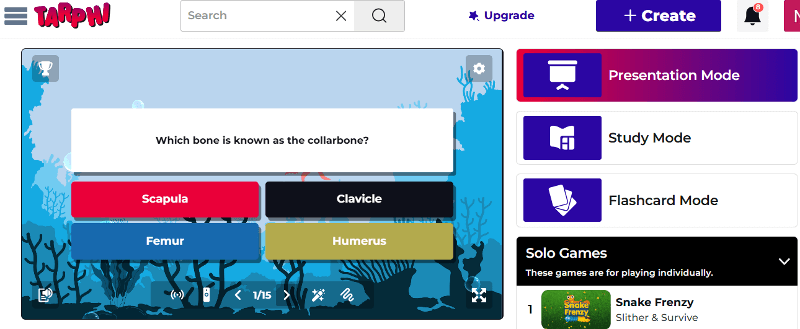
Tarphi is a K-12 teaching and learning platform designed for classrooms that want game-based engagement without losing instructional depth. While Blooket focuses mainly on fun game modes, Tarphi supports the full teaching flow: Create > Present > Assign > Assess.
Teachers can create quizzes, slides, and opinion polls manually, import existing materials, or use curriculum-aligned AI. The same content can then be reused across Presentation Mode, Study Mode, Flashcards Mode, Solo Games, and Competitive Games, something Blooket does not support.
Pros of Tarphi
Offers more question types, allowing deeper skill checks beyond basic recall.
Saves teachers' time with curriculum-aligned AI.
Supports formative assessment through opinion polls.
Provides clear learning analytics, not just game scores.
Keeps engagement high without relying only on speed or guessing.
Helps quieter or struggling students participate without pressure.
Works for full lessons, not just end-of-class games.
Pricing of Tarphi
Tarphi offers three flexible pricing plans: Basic, Standard, and Pro. The Basic plan is free. For individuals, Standard costs $7/month or $60/year ($5/month billed annually), and Pro costs $10/month or $96/year ($8/month billed annually). School plans are available at $55/year (Standard) and $90/year (Pro) per seat.
Why is Tarphi a Better Alternative for Blooket?
Tarphi is a stronger alternative because it keeps students engaged while adding what Blooket lacks: more question types, curriculum-aligned AI that saves time, opinion polls for checking understanding, and detailed reports that support real teaching decisions. Instead of being limited to game-based review, Tarphi helps teachers teach, assess, and improve learning, all in one platform.
2. Kahoot
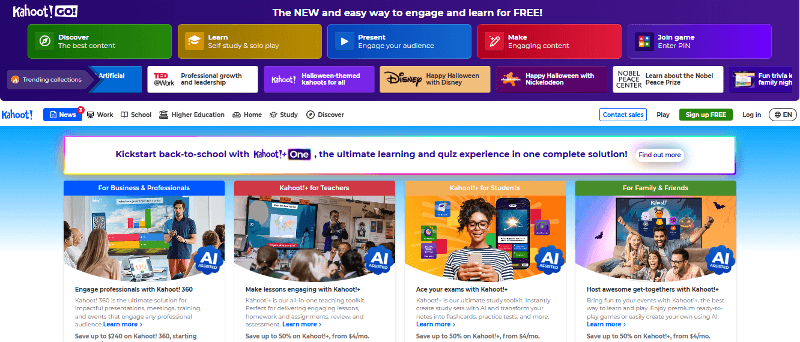
Kahoot is a game-based quiz platform built around speed and competition. Teachers run live quizzes, students join with a code, and points are awarded based on correct and fast responses. It works best for quick whole-class engagement and high-energy review sessions.
Pros of Kahoot
Easy to use and quick to launch, even for large classes.
Creates instant excitement and motivation through music, visuals, and leaderboards.
Strong live engagement that works well for quick reviews.
More question variety than Blooket, allowing broader review.
Large public libraries reduce prep time for simple quizzes.
Cons of Kahoot
Speed-based scoring often encourages guessing over thinking.
Question formats still miss some deeper academic types for ELA and language instruction.
Reports focus on scores rather than learning gaps or misconceptions.
AI content creation is faster, but not curriculum-aligned.
Costs increase quickly as advanced features and controls are unlocked.
Pricing of Kahoot
Kahoot uses a tiered pricing model where the free plan is very limited, and paid plans range from about $3 to $19 per month. As teachers need more players, AI tools, question types, and better reports, they must move to higher tiers, so costs increase quickly just to access basic teaching and assessment features.
3. Gimkit
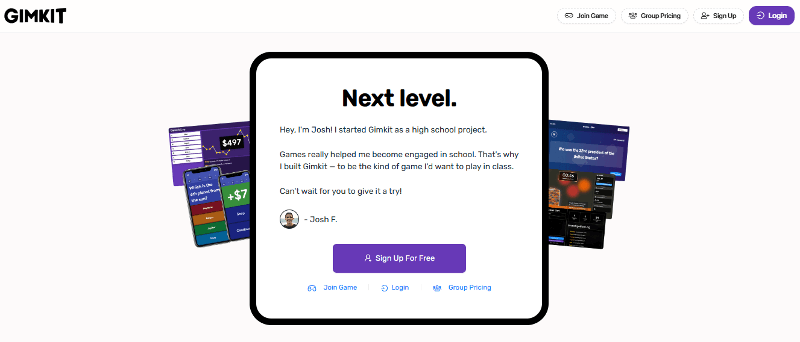
Gimkit is a strategy-based quiz game where students answer questions to earn currency (GimBucks) and spend it on upgrades inside modes like Fishtopia or Snowbrawl. It’s excellent for high-energy reviews, especially when you want a “video game” feel.
Pros of Gimkit
Strategy and upgrades keep students engaged longer than typical quiz games.
Encourages repeated play and persistence over multiple sessions.
Student-created questions (KitCollab) increase ownership.
Cons of Gimkit
Mainly built around multiple-choice and text-input questions, so deeper skill formats like matching, sequencing, and word scrambles aren’t supported.
Gameplay can pull focus toward upgrades instead of careful thinking.
Some modes can feel complex for younger students.
Reporting is focused on right/wrong, not deep explanations.
Pricing of Gimkit
Gimkit offers a free Basic plan with limited access. Gimkit Pro costs $14.99 per month or $59.88 per year (equivalent to $4.99/month when billed annually). Schools can also purchase Department plans ($650/year for up to 20 teachers) or a School plan ($1,000/year) that unlocks Pro features for all teachers in the building.
4. Wayground
Wayground (previously Quizizz) is a game-based learning platform that supports quizzes, lessons, passages, videos, and flashcards. It works for both live sessions and homework.
Pros of Wayground
More question variety allows better skill measurement.
Works well for homework and self-paced practice, so learning can continue outside class.
Answer explanations and accessibility support make practice more meaningful and inclusive.
Cons of Wayground
Less “game energy” than Blooket, so some students may find it less exciting in live play.
Some key monitoring tools and controls are reserved for school or district plans.
Not ideal when you want fast, arcade-style engagement.
Pricing of Wayground
Wayground offers a Basic plan for free, an Individual plan billed at $12 per month or $144 annually, and custom pricing options for schools and universities.
5. Mentimeter
Mentimeter is an interactive presentation tool widely used in universities, PD sessions, staff meetings, and conferences. It’s mainly designed for corporate settings and widely used for live polls, word clouds, ratings, and Q&A.
Pros of Mentimeter
Clean, professional slide designs that appeal to older students and adults.
Strong tools for live polls, word clouds, and anonymous Q&A.
Great for discussion-based lessons, seminars, and workshops.
Easy exporting of results for later review.
Cons of Mentimeter
Not built for K-12 curriculum alignment or standards.
No dedicated homework or assignment workflow.
Limited question formats for deep skill practice.
Reports focus on session summaries, not long-term student mastery.
Pricing of Mentimeter
Mentimeter has a free plan with limited slides. The Basic education plan costs about €10 per month, and the Pro plan costs about €16 per month (billed yearly). Institutional “Campus” plans provide additional features and administrative tools.
6. Wooclap
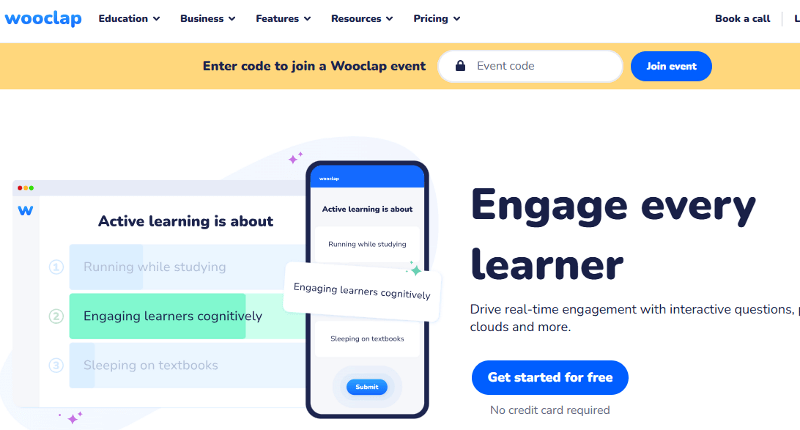
Wooclap is an audience-response platform used in lectures, webinars, and training. It focuses on live participation and feedback rather than student game avatars.
Pros of Wooclap
Excellent for real-time engagement during lectures (polls, word clouds, quick checks).
Good variety of interactive activity types for sessions.
Built around smooth “event” delivery and participation snapshots.
Cons of Wooclap
Homework is mostly self-paced questionnaires, not a full assignment workflow with teacher-grade controls.
AI is fast, but not designed for advanced curriculum alignment.
Analytics focus on participation and session results, not deep instructional insight.
Pricing of Wooclap
Wooclap offers a free plan with limits. The Education Basic plan is $7.99/month, and the Education Pro plan is $14.99/month (billed annually). Institutions can purchase custom enterprise plans with unlimited participants and integrations.
7. Slide with Friends
Slides With Friends is an interactive slide-based tool that helps teachers and hosts run fun polls, quizzes, and word clouds. Participants join instantly using a QR code or link, making it ideal for quick engagement, warm-ups, icebreakers, and group interaction rather than full academic teaching.
Pros of Slide with Friends
Extremely fast setup with a simple, teacher-friendly interface.
Great for warm-ups, icebreakers, and trivia.
Supports fun interaction types like word clouds, polls, photo sharing, and Apples-to-Apples-style voting.
Works smoothly in in-person or online settings.
Cons of Slide with Friends
Limited question formats compared with full learning platforms.
No detailed reports, analytics, or mastery tracking.
Not designed for structured lessons, homework, or long-term assessment.
Pricing of Slide with Friends
Slide With Friends has a free plan that includes all core features but supports only about 10–12 players per session. Paid plans are affordable and unlock higher player limits, more slides, custom branding, and additional presentation features. Pricing usually falls within a low, single-digit monthly cost.
8. Quizlet
Quizlet is built for self-paced study and memorization, especially vocabulary, definitions, formulas, and key facts.
Pros of Quizlet
Very simple and accessible for students and teachers
Offers multiple study modes: Flashcards, Learn, Test, Match, and Q-Chat
Great for vocabulary, definitions, exam prep.
Cons of Quizlet
Mostly focused on memorization and recall, not higher-order reasoning
Limited collaborative gameplay compared to Blooket-style tools
Fewer whole-class live game features
Pricing of Quizlet
Quizlet offers Quizlet Plus for Teachers at $35.99 per year (about $2.99/month) after a free 30-day trial. The plan includes unlimited study materials, ad-free student access, Quizlet Live customizations, and detailed student performance reports.
9. AhaSlides
AhaSlides is an interactive presentation platform that lets you build slide decks with built-in quizzes, polls, word clouds, and Q&A sessions. It’s used in education, workshops, and virtual events due to its flexibility and design.
Pros of AhaSlides
Combines slides, quizzes, polls, and surveys in one deck
Clean, modern interface for teachers and students
Works well for large classes and remote sessions
Cons of AhaSlides
Not designed specifically for K-12 mastery or standards
Limited assessment and long-term tracking structure
No built-in homework or assignment workflows
Pricing of AhaSlides
AhaSlides pricing includes a Free plan ($0) for 50 participants, an Essential plan at $7.95/month for 100 participants, a Pro (AI) plan at $15.95/month for 2,500 participants, and a custom-priced Enterprise plan for large organisations.
10. Nearpod
Nearpod is an interactive platform that helps teachers turn slides, videos, and PDFs into engaging lessons. It supports live participation, student-paced practice, and front-of-class teaching, making it suitable for homework and real-time instruction.
Pros of Nearpod
Supports different learning speeds with live, student-paced, and front-of-class modes.
Large library of standards-aligned, ready-to-teach lessons.
Better for full lesson delivery rather than quick game sessions.
Cons of Nearpod
Less exciting for short, high-energy review sessions.
Lacks game mechanics like coins, power-ups, avatars, or arcade-style modes.
More focused towards a teacher-paced, structured lesson flow, which some students might find less fun.
Pricing of Nearpod
Nearpod has a free Silver plan. Paid individual plans include Gold at $159/year and Platinum at $397/year. Schools and districts use custom-priced licenses with expanded features and higher student limits.
Conclusion
Now that you’ve seen the best Blooket alternatives, it’s clear that each platform offers something different, Kahoot brings real-time excitement, Gimkit adds strategy and rewards, Wayground supports full lessons, and Quizlet helps with self-paced study. Slide With Friends is great for quick, simple engagement, Nearpod works for real-time instruction, and AhaSlides offers a clean, presentation-style approach for older students or virtual classes. The right choice depends on your teaching style and what your students need.
If you want a single platform that blends fun gameplay with real learning depth, Tarphi is the strongest option. It offers interactive quizzes, curriculum-aligned AI, multiple learning modes, powerful reports, and easy lesson creation, all in one place. For teachers who want both engagement and meaningful instruction, Tarphi is the best alternative to Blooket.

Turn your lessons into interactive quizzes, games, and presentations.
No credit card required.