


Mentimeter is one of the most popular tools for interactive presentations. With live polls, word clouds, quizzes and Q&A, it turns lectures and meetings into two-way conversations instead of one-way slide shows. It’s clean, professional, and widely used in schools, universities, and corporate training.
However, as classrooms and training programs move toward deeper learning and data-informed instruction, many educators want more than slide-based interaction. They’re looking for stronger teaching workflows, richer academic question types, curriculum-aware AI, homework support, and analytics that actually help with teaching decisions, not just session engagement. That’s where Mentimeter lags behind.
If you like Mentimeter’s interactivity but want teaching power, this guide is for you. Below are 10 of the best Mentimeter alternatives to explore in 2026, with pros, cons, pricing, and why each platform can be a smarter fit depending on your needs.
Explore Mentimeter at a Glance
Mentimeter is an interactive presentation tool. You can build slide decks, add questions or activities, and invite participants to join with a code or link. As they respond, results appear live as bar charts, word clouds, or quiz leaderboards.
Why presenters and teachers like Mentimeter:
Polished, professional slide design
Fast live polling and visual feedback
Anonymous Q&A encourages participation
Works on any device smoothly
Why students or participants like it:
Easy to join with a code or link
Low-pressure participation
They can vote, answer, and ask questions without speaking
Why Look for Mentimeter Alternatives?
Mentimeter is great for presentations and quick interaction, but many teachers look for other tools when they need more than presentations. Common reasons to look for alternatives include:
It’s mostly for corporate usage, not for full lessons or daily teaching.
Limited academic question formats for real K-12 skill practice.
AI helps create questions, but it’s not tied to curriculum or grade level.
There’s no real homework or assignment system with deadlines or retries.
Reports show session-based and presenter-focused results, but not long-term student learning or gaps.
List of Top 10 Mentimeter Alternatives
1. Tarphi
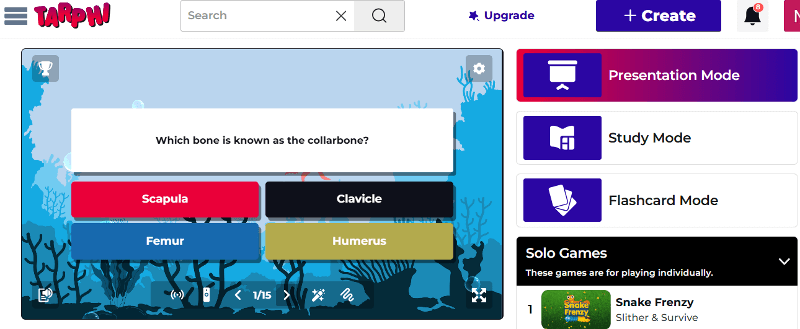
Tarphi is built specifically for classrooms, not presentations alone. While Mentimeter focuses on live interaction, Tarphi supports the entire teaching cycle: Create > Present > Assign > Assess
Teachers can build quizzes, slides, and opinion polls using AI or manually, import existing slides from PowerPoint or Google Slides, or get started with some class-ready templates. The same content can then be reused across multiple ways: Presentation mode, Study mode, Flashcards mode, Solo game, and Competitive game.
Pros of Tarphi
Designed for real classroom teaching, not just live interaction.
Supports live teaching, homework, practice, and assessment in one flow
Curriculum-aligned AI helps teachers create accurate, grade-appropriate content faster
Students learn from mistakes through answer explanations and feedback, not just scores.
Encourages quieter or struggling students to participate without pressure.
Multiple modes keep engagement and learning balanced and purposeful.
Real-time analytics that highlight student strengths, gaps, and misconceptions.
Pricing of Tarphi
Tarphi offers three flexible pricing plans: Basic, Standard, and Pro. The Basic plan is free. For individuals, Standard costs $7/month or $60/year ($5/month billed annually), and Pro costs $10/month or $96/year ($8/month billed annually). School plans are available at $55/year (Standard) and $90/year (Pro) per seat.
Why Tarphi Is a Better Alternative to Mentimeter
Mentimeter makes presentations interactive. Tarphi makes both teaching and learning interactive. It goes beyond live polls by supporting full lessons, real homework, faster and curriculum-aligned AI content generation, proper feedback, and analytics that guide teaching. If your goal is everyday classroom instruction not just engaging slides, then Tarphi is the more complete alternative.
2. Kahoot
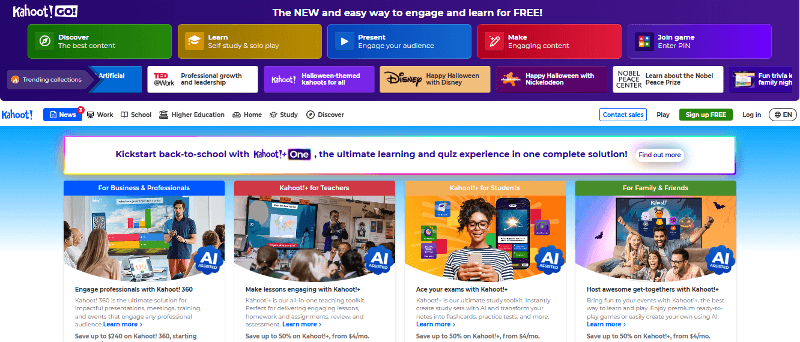
Kahoot is a fast-paced quiz platform built around speed and competition. It works best for energetic reviews and large-group engagement.
Pros of Kahoot
Extremely engaging for fast, energetic classroom moments
Very easy to set up and run with large groups
Works well when you want instant excitement and participation
Cons of Kahoot
Speed-based scoring can increase guessing and stress
Limited support for deeper learning, feedback, or reflection
Not suitable for structured lessons or long-term progress tracking
Pricing of Kahoot
Kahoot uses a tiered pricing model where the free plan is very limited, and paid plans range from about $3 to $19 per month. As teachers need more players, AI tools, question types, and better reports, they must move to higher tiers, so costs increase quickly just to access basic teaching and assessment features.
3. Wayground (formerly Quizizz)
Wayground is a game-based learning platform that supports quizzes, lessons, passages, videos, and flashcards. It’s popular in schools for both live sessions and homework.
Pros of Wayground
Strong for homework and self-paced practice
More flexible than Mentimeter for ongoing classroom use
AI question generation by subject, grade, standards, and DOK level.
Accessibility tools like read-aloud and dyslexia-friendly fonts.
Cons of Wayground
Live sessions feel calmer and less “event-like” than Mentimeter.
Game variety is modest compared to pure game platforms.
Pricing of Wayground
Wayground offers a Basic plan for free, an Individual plan billed at $12 per month or $144 annually, and custom pricing options for schools and universities.
4. AhaSlides
AhaSlides is an interactive presentation platform similar to Mentimeter. It lets you add polls, quizzes, surveys, Q&A, and word clouds into a slide deck that participants join with a link or code.
Pros of AhaSlides
Easy for participants to join and interact
Works well for lectures, workshops, and hybrid sessions
Often cheaper than some competitors for similar features.
Cons of AhaSlides
Not designed for K–12 learning progression.
Limited assessment structure and analytics compared to teaching platforms.
No real homework or assignment workflows.
Pricing of AhaSlides
AhaSlides pricing includes a Free plan ($0) for 50 participants, an Essential plan at $7.95/month for 100 participants, a Pro (AI) plan at $15.95/month for 2,500 participants, and a custom-priced Enterprise plan for large organisations.
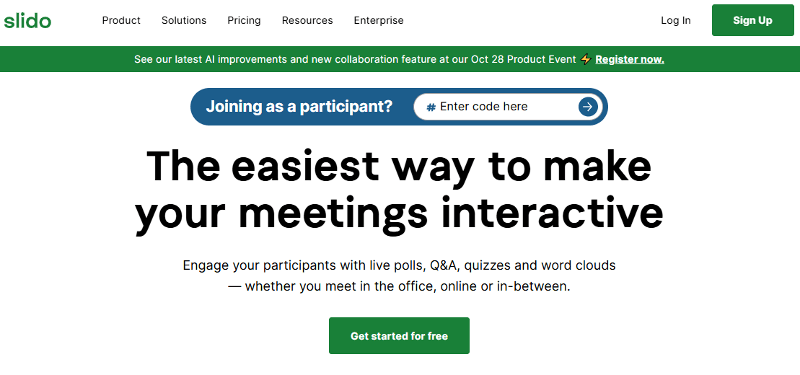
5. Slido
Slido is primarily built for Q&A and live polling in meetings, webinars, and large events. It integrates closely with tools like PowerPoint, Google Slides, and Microsoft Teams.
Pros of Slido
Excellent audience Q&A with upvoting and moderation.
Keeps big lectures and events interactive.
Integrates smoothly with presentation and meeting tools.
Cons of Slido
Mainly event-focused, not classroom-focused
Minimal support for skill practice or learning progression
Reporting emphasizes participation, not understanding.
Pricing of Slido
Slido has a free plan for up to 100 participants with basic Q&A and 3 polls per session. Paid annual plans start at $12.50/month (Engage) for up to 200 participants, $50/month (Professional) for 1,000 participants, and $150/month (Enterprise) for 5,000 participants, all billed annually. One-time event plans are also available, starting at $80 per event, with discounted education plans for schools and universities.
6. Poll Everywhere
Poll Everywhere is a long-standing audience response tool that lets you embed live polls, multiple-choice questions, word clouds, and open responses directly in PowerPoint, Google Slides, and Keynote. Participants can respond via web or SMS.

Pros of Poll Everywhere
Excellent for quick checks for understanding during lectures.
Supports SMS responses, making it useful in low-device or low-bandwidth environments.
Very reliable and stable for higher education lectures and formal settings
Cons of Poll Everywhere
Feels more functional than engaging for younger learners
Not suitable for long-term learning analytics
Limited insight into individual learner progress
Pricing of Poll Everywhere
Poll Everywhere has a free plan for up to 40 participants. Paid education plans start at $9/month ($108/year) for up to 700 students, increase to $16/month and $27/month for larger classes and reporting features, with custom-priced campus plans available. Business plans start at $10/month and scale higher based on audience size and team needs.
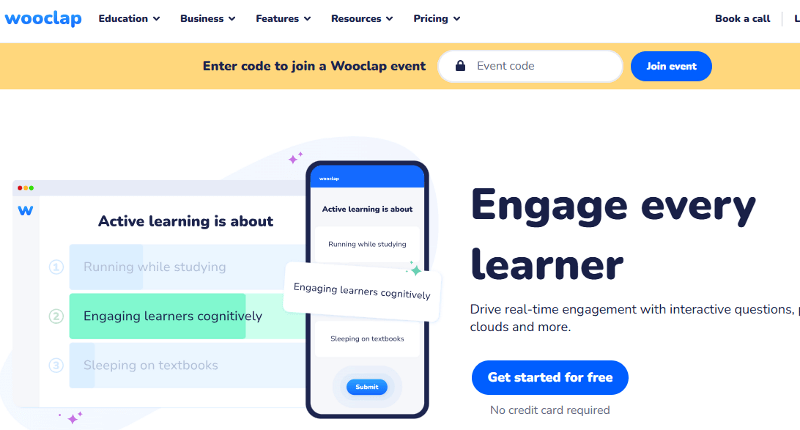
7. Wooclap
Wooclap is an audience response system used widely in higher education and training. It supports a large range of interactive question types for lectures, workshops, and webinars.
Pros of Wooclap
Wide range of interaction types supports conceptual questioning
Keeps large lectures active and participatory
Useful for higher education and professional training
Cons of Wooclap
Built for events, not regular K-12 classes.
No meaningful homework or mastery tracking.
Pricing of Wooclap
Wooclap offers a free plan with limits. The Education Basic plan is $7.99/month, and the Education Pro plan is $14.99/month (billed annually). Institutions can purchase custom enterprise plans with unlimited participants and integrations.
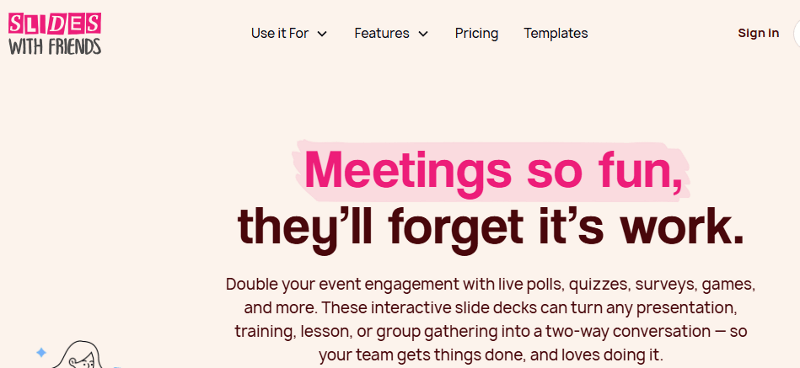
8. Slides With Friends
Slides With Friends is an interactive slide-based tool for quizzes, polls, word clouds, and games. You create a deck in a PowerPoint-style interface; participants join via QR code or link and play along on their phones.
Pros of Slides With Friends
Very fast setup for polls, icebreakers, and discussion starters
Encourages participation without pressure
Works well for informal engagement moments
Cons of Slides With Friends
Not suitable for structured teaching or assessment.
Limited curriculum alignment or standards support.
Analytics and reports are basic and session-focused.
Pricing of Slides With Friends
Slide With Friends has a free plan that includes all core features but supports only about 10–12 players per session. Paid plans are affordable and unlock higher player limits, more slides, custom branding, and additional presentation features. Pricing usually falls within a low, single-digit monthly cost.
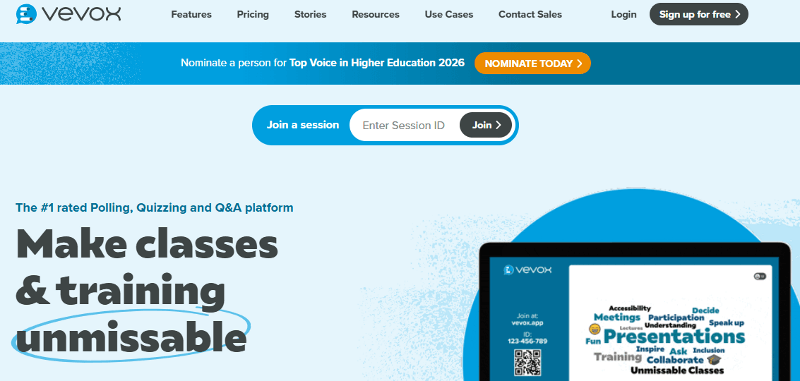
9. Vevox
Vevox is an audience engagement platform with live polling, Q&A, and surveys, used widely in universities and corporate training.
Pros of Vevox
Strong for anonymous polling and Q&A in formal settings
Designed specifically for higher education and corporate training
Offers strong moderation and security features.
Cons of Vevox
More focused on lectures and training events than daily K-12 classes.
Learning analytics focus on feedback, not mastery.
Less suitable for younger learners.
Pricing of Vevox
Vevox offers a Free education plan at $0. Paid educator plans are billed annually: Starter is $7.75/month ($93/year), and Pro is about $12.95/month ($143.52/year). For departments or institutions, Institution pricing is custom (typically based on active users).
10. Nearpod
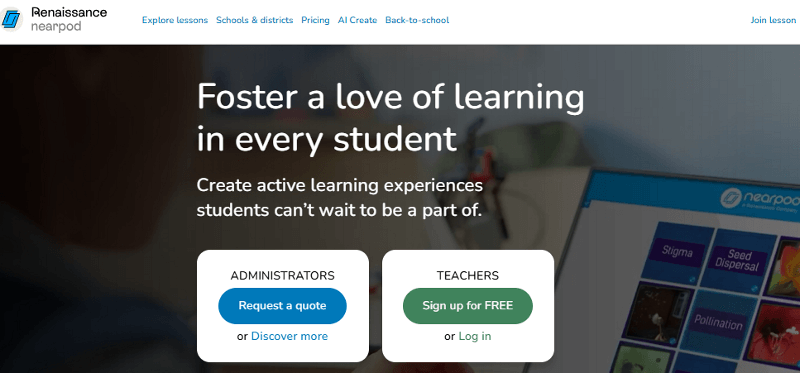
Nearpod is a digital presentation platform designed for full classroom instruction rather than slide-based polling. Unlike Mentimeter, which focuses on live interaction during presentations, Nearpod allows teachers to run complete lessons with slides, videos, interactive questions, and student-paced activities in one structured flow.
Pros of Nearpod
Supports different learning speeds with live, student-paced, and front-of-class modes.
Strong for asynchronous learning and homework, which Mentimeter does not support.
Large library of standards-aligned, ready-to-teach lessons.
Better for full lesson delivery rather than quick game sessions.
Cons of Nearpod
Less suitable for fast, lightweight polling or spontaneous audience interaction compared to Mentimeter.
Engagement feels more instructional than playful; not ideal for energizing events or workshops.
Advanced reports, storage, and features are locked behind higher-priced plans.
Pricing of Nearpod
Nearpod has a free Silver plan. Paid individual plans include Gold at $159/year and Platinum at $397/year. Schools and districts use custom-priced licenses with expanded features and higher student limits.
Conclusion
Mentimeter is excellent for polished, interactive presentations, but it doesn’t cover everything teachers and trainers need, especially in K–12 classrooms. Each of the above alternatives brings something different.
Kahoot brings high-energy, competitive quiz play, Wayground supports quizzes and assignments with standards-aware AI. AhaSlides, Slido, Poll Everywhere, Wooclap, and Vevox are good for lectures, events, and professional training.
Blooket and Gimkit offer playful or strategic game-based review, Slides With Friends provides quick, lightweight interaction, while Nearpod focuses on lesson delivery.
If you’re looking for one platform that combines interactive sessions with serious teaching tools, Tarphi stands out. It supports AI-powered curriculum-aligned content, multiple modes (presentation, study, flashcards, solo and competitive review games), structured homework, and deep analytics, making it one of the strongest alternatives to Mentimeter for everyday K–12 instruction.

Turn your lessons into interactive quizzes, games, and presentations.
No credit card required.